
In today’s digital learning landscape, educators face a major challenge: learners are often overwhelmed with too much information, presented too quickly, and structured without a clear learning pathway.
The result?
Confusion, frustration, disengagement — and poor learning outcomes.
This is not a technology problem.
It is a cognitive problem. And its solution lies in one of the most influential instructional design principles ever created:
Cognitive Load Theory (CLT).
As digital learning expands, CLT has become critical for designing content that is easy to understand, mentally manageable, and instructionally effective. And now, with AI-powered tools like HACC Gen, CLT is no longer difficult to apply — it becomes automatic, scalable, and built into the design process itself.
This blog explores how Cognitive Load Theory works, why it matters, and how HACC Gen uses this theory to create powerful Moodle learning experiences.
Understanding Cognitive Load Theory: What It Really Means for Learners
Cognitive Load Theory, developed by psychologist John Sweller, explains how our working memory processes new information.
Working memory is limited, and when it becomes overloaded, learning stops — no matter how motivated the learner may be.
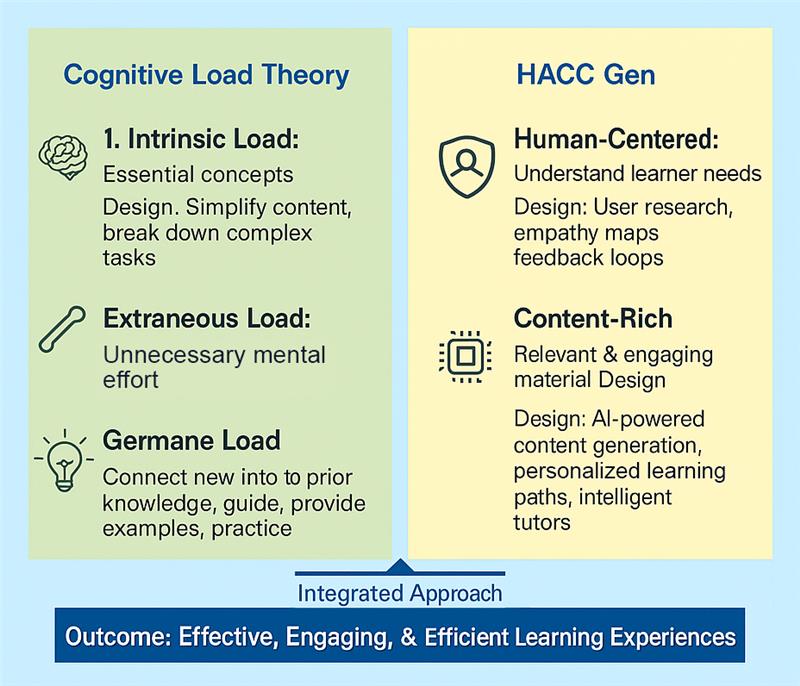
CLT breaks cognitive load into three types, each playing a role in how effectively learning happens:
-
Intrinsic Load — The Difficulty of the Topic Itself
Every subject has a natural level of complexity.
For example, learning basic vocabulary has a lower intrinsic load than solving calculus problems.
Educators cannot remove intrinsic load — but they can break content into smaller, more digestible pieces.
-
Extraneous Load — The Confusion Caused by Poor Design
This is the most harmful type of load and the most common in LMS courses.
Extraneous load comes from:
- Long, unstructured paragraphs
- Irrelevant content
- Poor layout
- Unclear instructions
- Overly complex visuals
- Missing context
Reducing extraneous load improves clarity and comprehension immediately.
-
Germane Load — The Mental Effort Used to Build Knowledge
Germane load is a good load — effort spent understanding, connecting ideas, and applying knowledge.
CLT aims to reduce extraneous load, manage intrinsic load, and maximize germane load.
When done right, learners:
- Understand more
- Learn faster
- Retain knowledge longer
When done wrong, cognitive overload blocks learning entirely.
Why Cognitive Load Theory Matters in Digital Learning
Online learning environments amplify the risk of overload.
Learners face:
- Multiple tabs
- Notifications
- Dense modules
- Text-heavy content
- Poorly planned activities
- Lack of progression
This is why CLT is more important today than ever.
Course creators must design materials that respect the limits of working memory.
But most educators do not have time to manually rewrite every lesson, simplify content, reorganize structure, or apply CLT principles repeatedly.
This is where HACC Gen transforms the process.
How HACC Gen Uses Cognitive Load Theory to Build Better Moodle Courses
HACC Gen (Human–AI Collaborative Content Generator) is an AI-powered Moodle plugin built specifically around instructional design frameworks — including Cognitive Load Theory.
Instead of educators struggling to manually reduce cognitive load, HACC Gen builds CLT principles directly into the course creation workflow.
Here’s how:
-
HACC Gen Breaks Content into Clear, Structured Sections
Long, dense blocks of text are the #1 cause of extraneous cognitive load.
HACC Gen automatically divides content into:
- Logical sections
- Topic-based subsections
- Headings and subheadings
- Bullet points
- Step-by-step explanations
This instantly improves readability and reduces mental overload.
Learners process information faster and more comfortably — just as CLT recommends.
-
HACC Gen Simplifies Explanations Without Losing Meaning
Complex explanations increase intrinsic load unnecessarily.
HACC Gen refines content by:
- Rewriting complicated sentences
- Clarifying definitions
- Offering examples
- Providing analogies
- Summarizing key ideas
This maintains accuracy while making learning easier — a direct application of CLT.
-
HACC Gen Builds Progressive Learning Paths
One of the core CLT strategies is scaffolding: starting simple and gradually increasing complexity.
HACC Gen automatically creates progression by:
- Introducing basic concepts first
- Gradually adding depth
- Connecting ideas step-by-step
- Aligning content with Bloom’s Taxonomy
This ensures learners never encounter advanced complexity before they’re ready.
-
HACC Gen Reduces Extraneous Load With Clean, Minimalist Outputs
Extraneous load often comes from:
- Overloaded paragraphs
- Context jumping
- Unnecessary examples
HACC Gen eliminates these by generating clean, focused, structured learning materials.
The plugin keeps content aligned, relevant, and easy to absorb.
-
HACC Gen Generates Activities That Strengthen Germane Load
To reinforce learning, CLT encourages activities that engage the brain constructively.
HACC Gen generates:
- Bloom-aligned questions
- Case-based scenarios
- Application exercises
- Reflection prompts
- Real-world examples
These activities increase germane load — the mental effort that builds understanding.
This results in deeper, more meaningful learning.
Why Cognitive Load Theory + HACC Gen Is a Game Changer
When CLT and AI come together, digital learning improves dramatically. Institutions benefit from:
✔ Faster course creation
✔ Higher content clarity
✔ Better learner comprehension
✔ Improved retention
✔ Consistent instructional design
✔ Reduced educator workload
Educators no longer need to spend hours rewriting lessons or restructuring modules.
HACC Gen automates the structure — educators refine and personalize.
This is Human–AI collaboration at its best:
AI handles the cognitive design; humans handle the teaching.
Real Benefits for Institutions and Educators
- Better Learning Outcomes: – Courses become easier to follow and understand.
- Huge Time Savings: – Complex instructional design work happens in minutes.
- Stronger Knowledge Retention: – Learners process information more effectively.
- Consistent Course Quality: – Every module follows a CLT-backed structure.
- More Time for Creativity: – Educators focus on teaching, not formatting.
Conclusion: The Future of Learning Respects the Brain
Cognitive Load Theory teaches us one important lesson:
Learning improves when we respect the limits of working memory.
HACC Gen takes this principle and transforms it into an AI-powered advantage — instantly applying CLT to every course created in Moodle.
By combining human expertise with AI intelligence, HACC Gen ensures that digital learning is:
- Clear
- Structured
- Engaging
- Manageable
- Effective
This is not just faster course creation — it is smarter course creation.
When Cognitive Load Theory and HACC Gen work together, learners don’t just receive information…
They understand it. They retain it. They succeed.
HACC Gen is developed by Dynamic Pixel Multimedia Solutions —
a Certified Moodle Partner empowering organizations worldwide with next-generation e-learning and AI-driven solutions.