
In today’s fast-evolving digital learning environment, creating effective courses is no longer just about good content—it’s about structured design, consistency, and measurable outcomes. As organizations scale online learning, the need for a reliable instructional framework becomes critical. This is where the ADDIE Model plays a foundational role.
The ADDIE Model—Analyze, Design, Develop, Implement, and Evaluate—is one of the most widely adopted instructional design frameworks in education and corporate training. It provides a systematic, step-by-step approach to course creation that ensures clarity, alignment, and quality throughout the learning lifecycle.
With the emergence of AI-powered tools, applying ADDIE no longer needs to be time-consuming or complex. HACC Gen, an AI-powered Moodle plugin developed by Dynamic Pixel Multimedia Solutions, integrates the ADDIE model directly into course creation—making structured, high-quality learning faster and more scalable than ever before.
What Is the ADDIE Model?
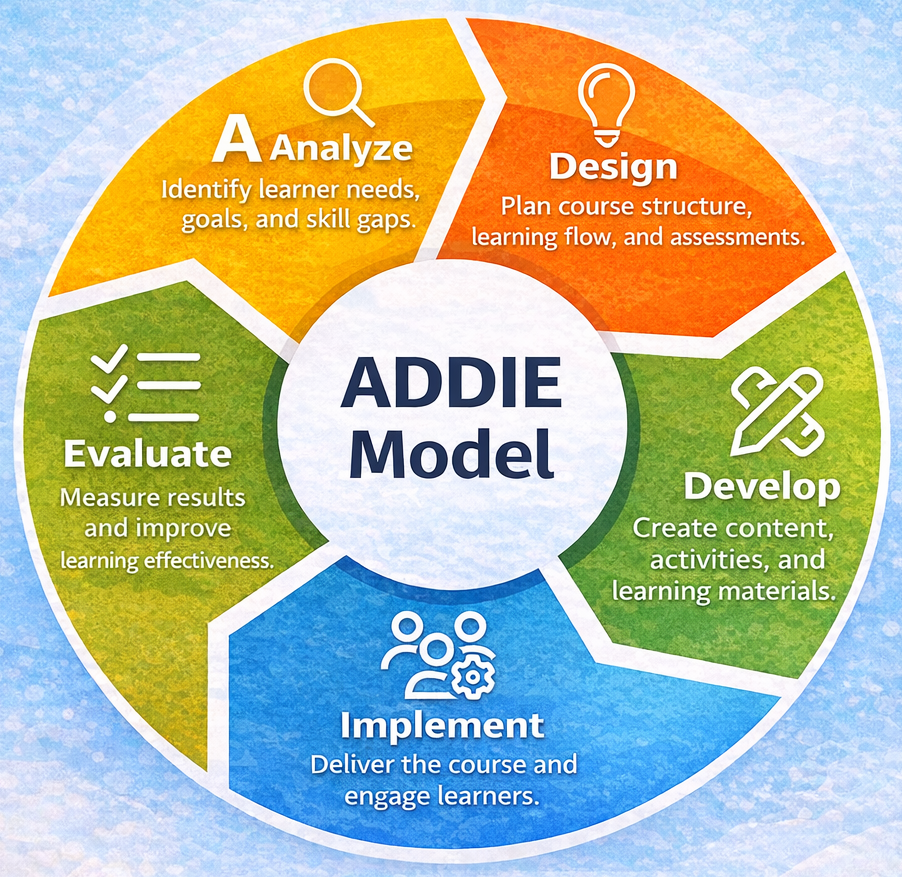
The ADDIE Model is a structured framework used by instructional designers to plan, build, and evaluate learning experiences. Each phase builds on the previous one, ensuring that learning is purposeful, learner-centered, and outcome-driven.
The five phases include:
- Analyze – Understand learner needs and goals
- Design – Plan learning objectives, content flow, and assessments
- Develop – Create instructional materials and activities
- Implement – Deliver the course through the LMS
- Evaluate – Measure effectiveness and improve continuously
Together, these phases provide a clear roadmap for systematic course design.
Why the ADDIE Model Matters in E-Learning
Digital learning environments demand consistency, scalability, and quality. Without a structured framework, courses can become fragmented, misaligned, or ineffective.
The ADDIE Model helps address these challenges by:
- Ensuring clear learning objectives
- Aligning content with outcomes
- Supporting learner-centered design
- Reducing guesswork in course creation
- Enabling continuous improvement
For institutions managing multiple courses, instructors, and learner groups, ADDIE provides the structure needed to maintain quality at scale.
How HACC Gen Applies the ADDIE Model in Moodle
HACC Gen is designed to simplify instructional design by embedding ADDIE principles directly into AI-powered content generation. Instead of educators manually executing each phase, HACC Gen supports and accelerates them—while keeping humans in control.
Let’s explore how HACC Gen aligns with each ADDIE phase.
-
Analyze: Understanding Learners and Objectives
The Analyze phase focuses on identifying learner needs, skill gaps, and learning goals. Traditionally, this requires time-consuming planning and documentation.
HACC Gen supports this phase by:
- Assisting in defining clear learning objectives
- Structuring course outlines based on goals
- Aligning content with learner levels and outcomes
This ensures that every course begins with a strong instructional foundation.
-
Design: Planning Structured Learning Experiences
The Design phase determines how learning will occur—content structure, assessments, activities, and flow.
HACC Gen applies this phase by:
- Creating logical module and lesson structures
- Aligning content with Bloom’s Taxonomy
- Suggesting assessments and activities
- Ensuring progression from simple to complex concepts
This design-first approach prevents random content creation and supports learner engagement.
-
Develop: Rapid Content Creation with Quality Control
The Develop phase is where content comes to life. However, this stage often consumes the most time.
HACC Gen accelerates development by generating:
- Lesson explanations
- Topic summaries
- Quizzes and assessments
- Practice activities and examples
Educators then review, refine, and contextualize the content—maintaining quality while saving significant time.
-
Implement: Seamless Delivery in Moodle
Implementation focuses on delivering the course effectively through the LMS.
Because HACC Gen is built specifically for Moodle, it ensures:
- LMS-ready course structures
- Consistent formatting across modules
- Easy deployment and updates
- Compatibility with Moodle activities and resources
Courses created with HACC Gen are structured, organized, and ready for immediate use.
-
Evaluate: Continuous Improvement and Refinement
Evaluation ensures that learning objectives are met and identifies areas for improvement.
HACC Gen supports evaluation by:
- Making content updates fast and consistent
- Enabling iterative improvements
- Supporting feedback-driven refinements
- Helping maintain alignment across course updates
This allows institutions to continuously enhance learning quality without redesigning courses from scratch.
Benefits of ADDIE + HACC Gen for Organizations
When the ADDIE Model is combined with AI-powered automation, organizations gain powerful advantages:
(i) Consistent Course Quality
Every course follows the same structured framework.
(ii) Faster Course Development
AI reduces manual effort while preserving instructional integrity.
(iii) Scalable Learning Design
Institutions can expand course libraries efficiently.
(iv) Reduced Instructional Design Workload
Educators focus on facilitation and improvement rather than formatting.
(v) Measurable Learning Outcomes
Clear objectives and assessments support evaluation and reporting.
Use Cases Across Learning Environments
Higher Education
Ensure curriculum consistency across departments and programs.
Corporate Training
Deliver structured, repeatable training aligned with business goals.
Professional Development
Create clear learning pathways for skill-building and certification.
EdTech Platforms
Scale content creation while maintaining instructional quality.
Dynamic Pixel & HACC Gen: Systematic Learning, Simplified
As a Certified Moodle Partner, Dynamic Pixel Multimedia Solutions develops AI-powered solutions that blend instructional science with modern technology. HACC Gen, developed by Dynamic Pixel, brings the proven ADDIE framework into the heart of Moodle—helping educators and organizations create structured, high-quality courses faster and more efficiently.
By combining systematic course design with AI assistance, HACC Gen ensures learning experiences remain consistent, scalable, and aligned with educational best practices.
Conclusion
The ADDIE Model remains one of the most reliable frameworks for instructional design because it provides clarity, structure, and measurable outcomes. However, applying ADDIE manually can be time-intensive—especially in large-scale digital learning environments.
With HACC Gen, the ADDIE framework becomes easier to implement and scale. AI assists with analysis, structure, and content generation, while educators guide, contextualize, and evaluate learning experiences.
The result is systematic, high-quality course design—built for the demands of modern digital education.