
In today’s digital-first learning environment, education has moved far beyond static text and PDFs. Videos, visuals, audio, animations, and interactive elements are now central to how learners engage with content. However, the presence of multimedia alone does not guarantee effective learning. In fact, poorly designed multimedia can overwhelm learners, distract attention, and reduce knowledge retention.
This is where Richard Mayer’s Multimedia Learning Theory becomes critically important. Grounded in decades of cognitive science research, Mayer’s theory explains how people learn from words and pictures—and, more importantly, how educators can design multimedia content that truly supports understanding.
At the intersection of this proven learning science and modern educational technology lies HACC Gen, a Human–AI Collaborative Content Generator designed specifically for Moodle-based course creation. By embedding Mayer’s principles into AI-assisted content design, HACC Gen helps educators create courses that are engaging, structured, and instructionally sound.
The Challenge with Modern Multimedia Learning
As learning platforms evolve, educators face increasing pressure to make courses more engaging. Videos, infographics, voiceovers, and interactive elements are often added to improve learner experience. Yet without a clear instructional framework, multimedia can quickly become excessive rather than effective.
Common issues include:
- Too much information is presented at once
- Visuals that distract rather than explain
- Text and narration that repeat the same information
- Learners are struggling to identify what is truly important
The result is cognitive overload—when learners’ mental processing capacity is exceeded, leading to confusion, fatigue, and reduced learning outcomes. Mayer’s Multimedia Learning Theory directly addresses these challenges by explaining how the human brain processes information and how multimedia should be designed accordingly.
Understanding Mayer’s Multimedia Learning Theory
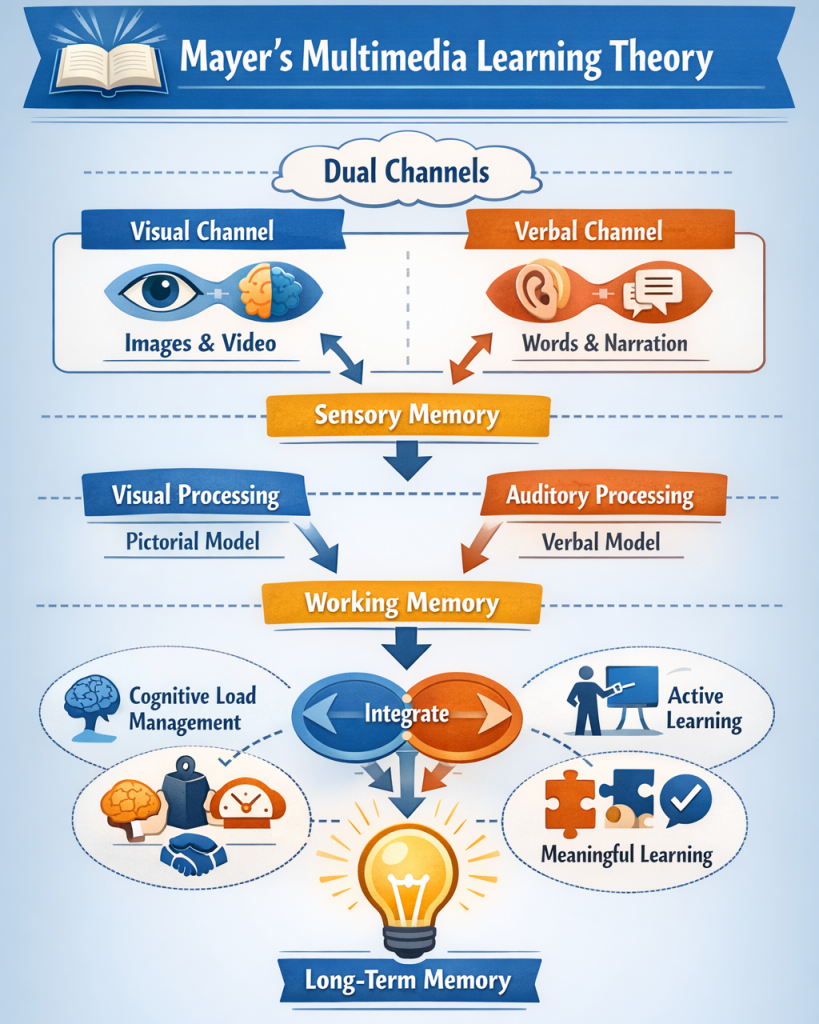
At the core of Mayer’s theory is the concept of dual-channel learning. Humans process information through two separate channels:
- Visual channel – for images, diagrams, videos, and animations
- Verbal channel – for spoken words and written text
These channels feed into working memory, which has limited capacity. Effective learning occurs when instructional content is designed to balance both channels without overwhelming either one.
Mayer’s theory emphasizes that learners actively construct knowledge by:
- Selecting relevant information
- Organizing it into meaningful mental models
- Integrating new knowledge with existing understanding
Multimedia learning is most effective not when more media is added, but when media is purposefully aligned with how the brain learns.
Key Principles of Effective Multimedia Learning
Mayer’s research highlights several core principles that guide effective instructional design:
- Alignment of Words and Visuals
Text, narration, and visuals should complement each other, not duplicate or compete for attention. When visuals explain concepts that words alone cannot, comprehension improves significantly.
- Managing Cognitive Load
Content should be broken into manageable segments. Presenting information step by step allows learners to process and retain knowledge more effectively.
- Focus on Essential Information
Learners should be guided toward what truly matters. Extraneous graphics, sounds, or animations—even if visually appealing—can distract from learning goals.
- Support for Active Learning
Effective multimedia encourages learners to think, reflect, and integrate information rather than passively consume content.
The goal is not more media, but better-integrated media.
How HACC Gen Applies Mayer’s Multimedia Learning Theory
HACC Gen operationalizes Mayer’s theory through AI-assisted course design while keeping educators firmly in control. Rather than generating random or generic content, HACC Gen follows instructional science to guide how multimedia elements are structured and combined.
Balanced Use of Text, Visuals, and Audio
HACC Gen helps structure content so that visuals support explanations instead of repeating them verbatim. This balance ensures that both visual and verbal channels are used efficiently.
Reduced Cognitive Overload
AI-generated content is organized into clear, focused sections. Information is segmented logically, enabling learners to process concepts gradually rather than being overwhelmed.
Purposeful Multimedia Integration
Videos, diagrams, examples, and explanations are aligned directly with learning objectives. Each multimedia element serves a clear instructional purpose.
Learner-Focused Presentation
Clarity, coherence, and simplicity are prioritized. HACC Gen follows multimedia learning principles that keep attention on essential ideas while minimizing unnecessary complexity.
Importantly, educators remain in control. AI assists in structuring and generating content, but instructors review, refine, and contextualize material to ensure accuracy, relevance, and alignment with course goals.
Why Mayer’s Theory Combined with HACC Gen Matters
When instructional science meets AI-driven efficiency, the impact on learning design is significant. By applying dual-channel learning principles through AI-assisted workflows, HACC Gen enables institutions to:
- Improve learner comprehension and long-term retention
- Create engaging yet focused multimedia-rich courses
- Reduce unnecessary complexity in instructional design
- Deliver consistent, high-quality learning experiences at scale
Rather than replacing educators, HACC Gen enhances their ability to design effective courses—saving time while maintaining pedagogical integrity.
Bridging Learning Science and AI Innovation
Mayer’s Multimedia Learning Theory provides a research-backed foundation for how learning works. HACC Gen transforms that theory into a practical, scalable application within Moodle environments. Together, they help ensure that multimedia content is not just engaging but meaningful.
In an era where AI is rapidly reshaping education, grounding innovation in proven learning science is essential. By combining instructional theory with intelligent content generation, educators can design courses that respect how the brain learns—while meeting the demands of modern digital education.
HACC Gen, developed by Dynamic Pixel Multimedia Solutions, represents this balance of science and innovation—empowering educators to design multimedia-rich courses that truly support learning, understanding, and long-term success.