
As digital learning continues to expand across industries, organizations are rethinking how they design training that is not only informative but also engaging, repeatable, and effective. At the center of this evolution is one of the most influential learning theories in education and psychology:
Behaviorism.
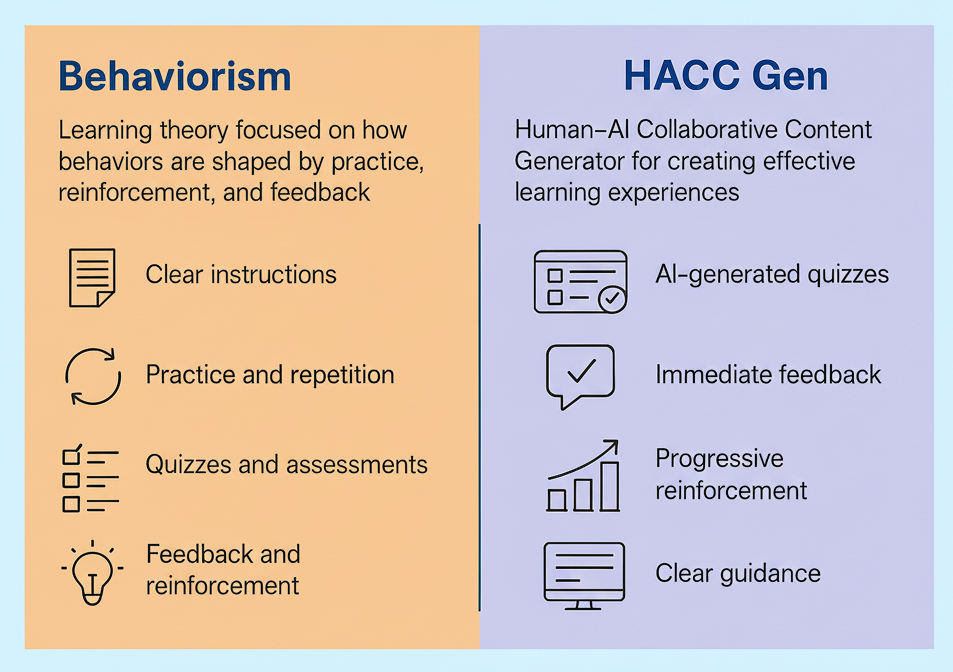
Behaviorism explains how learners build new skills through repetition, reinforcement, and structured feedback. It has influenced everything from classroom teaching techniques to digital simulations and corporate e-learning systems. Today, this theory plays a critical role in how AI-powered tools like HACC Gen help educators and trainers create high-quality content efficiently.
In this blog, we explore how Behaviorism and reinforcement learning work, why they matter in digital training, and how HACC Gen integrates these principles to deliver smarter learning experiences within Moodle.
Understanding Behaviorism: Learning Through Action and Feedback
Behaviorism focuses on observable behavior and how learning occurs through stimulus and response. According to this theory, learners improve when they consistently receive:
- A clear task or question (stimulus)
- Their response or attempt (behavior)
- Immediate reinforcement or feedback
The goal is to strengthen correct behaviors and reduce incorrect ones. This repetitive cycle results in strong learning habits and measurable improvement.
In simple terms:
Behaviorism = Practice + Feedback → Improved Performance
This approach continues to dominate e-learning because digital environments rely heavily on structured tasks, quizzes, scenarios, and automated responses — all core components of Behavioral learning.
Reinforcement Learning: The Engine of Skill Development
Reinforcement is the heart of Behaviorism. It includes:
- Positive reinforcement: – Rewarding or highlighting correct answers to build confidence and motivation.
- Negative reinforcement: – Reducing confusion or obstacles to help learners reach the correct answer more easily.
- Corrective feedback: – Providing clear explanations when a learner responds incorrectly.
These reinforcement loops strengthen learning pathways in the brain. In corporate training, where learners are often busy and multitasking, reinforcement ensures they remain engaged, focused, and aware of their progress.
Effective reinforcement leads to:
- Faster skill acquisition
- Greater retention
- Improved accuracy
- Higher learner satisfaction
When done poorly, however, learners feel lost, overwhelmed, or unmotivated.
This is exactly where modern AI tools make a difference.
How Digital Learning Naturally Supports Behavioral Theory
e-Learning ecosystems are uniquely aligned with Behaviorism because they can easily embed:
- Repetition through quizzes and tasks
- Automated scoring
- Instant feedback messages
- Rewards (badges, progress bars, certificates)
- Reinforcement loops within modules
In platforms like Moodle, Behaviorism comes to life through structured learning pathways, activity-based modules, practice quizzes, and feedback-driven evaluations.
Yet creating all this manually — lesson after lesson, module after module — is time-consuming for educators.
That’s where HACC Gen makes an impact.
How HACC Gen Uses Behaviorism and Reinforcement Learning to Build Better Courses
HACC Gen (Human–AI Collaborative Content Generator) is designed not just to produce content quickly but to produce instructionally sound content grounded in proven learning science. Behaviorism is one of the key theories embedded into its design.
Here’s how HACC Gen applies these principles:
-
AI-Generated Quizzes That Reinforce Learning
Quizzes are the backbone of behaviorist learning.
HACC Gen automatically generates:
- Multiple-choice questions
- True/false items
- Scenario-based questions
- Short-answer prompts
- Bloom-aligned assessments
These quizzes help learners revisit essential concepts repeatedly — strengthening retention.
Instead of spending hours writing assessments, educators simply review and refine what AI generates.
-
Immediate Feedback Loops Built Into Learning Activities
Behaviorism emphasizes instant response.
Learners perform best when they know immediately:
- What they did right
- What they misunderstood
- How can they improve
HACC Gen supports this by generating:
- Positive reinforcement for correct answers
- Clear explanations for incorrect responses
- Guided prompts that encourage better understanding
- Action-based feedback aligned with learning outcomes
This automated structure drastically improves learner engagement and motivation.
-
Progressive Learning Through Structured Skill-Building
Behaviorism thrives on repetition and gradual skill enhancement.
HACC Gen applies this by:
- Breaking content into smaller, manageable units
- Creating scaffolding from simple to complex
- Reinforcing key concepts at multiple points
- Ensuring continuity between modules
This mirrors how humans naturally build habits — reinforcing correct cognitive patterns over time.
-
Crystal-Clear Instructions That Reduce Cognitive Overload
Behaviorist design works best when instructions are:
- Direct
- Simple
- Action-oriented
HACC Gen simplifies content automatically, reducing unnecessary complexity and supporting clarity.
This helps learners focus on the task, not struggle to decode confusing language.
-
Activities That Strengthen Behavioral Learning
HACC Gen generates:
- Practice questions
- Case studies
- Real-world scenarios
- Role-based exercises
- Application tasks
These strengthen germane load (effort focused on learning) while reinforcing correct behaviors repeatedly.
The result is a training experience that is grounded in proven learning science — not just text generated for convenience.
Why Behaviorism + HACC Gen Creates Better Training Outcomes
When Behaviorism and AI come together, organizations gain powerful advantages:
- Consistent training quality: – AI ensures every module has structured reinforcement.
- aster content development: – Educators save hours of manual writing.
- Higher engagement: – Reinforcement loops keep learners active and motivated.
- Better retention: – Repeated exposure solidifies understanding.
- Reduced cognitive load: – Clear instructions and targeted tasks improve focus.
- Scalable training: – AI allows institutions to expand course libraries without sacrificing instructional quality.
This combination makes digital learning not only efficient but scientifically grounded and highly effective.
Dynamic Pixel: Advancing the Future of Intelligent Learning
As a Certified Moodle Partner and leader in AI-powered education, Dynamic Pixel Multimedia Solutions is committed to helping organizations deliver smarter, reinforcement-driven learning experiences. With innovative solutions like HACC Gen, we enable teams to create structured, engaging, and instructionally sound training faster than ever before. Our focus on scalability, personalization, and proven learning science ensures that institutions stay ahead in a rapidly evolving digital world — one intelligently designed training experience at a time.